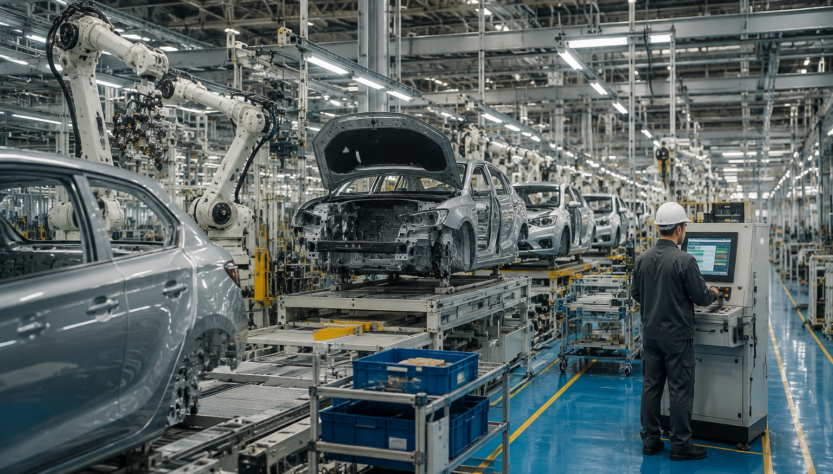
Vehicle production is often discussed in terms of completed cars, but the broader Philippine automotive industry includes hundreds of companies involved in parts, materials, engineering, logistics, maintenance, and specialized equipment.
Every locally assembled vehicle requires seats, glass, wiring, tires, batteries, metal panels, plastic components, electronic modules, and interior systems. When these products are sourced domestically, the economic benefit of vehicle manufacturing becomes significantly greater.
Manufacturing statistics and industry indicators published by the Philippine Statistics Authority provide useful information for monitoring transport-equipment production and wider industrial performance.
A strong supplier sector creates skilled employment and allows manufacturers to respond more quickly to production requirements. It can also help Philippine companies enter international automotive supply chains.
Electronics Expertise Could Become a Strategic Advantage
The Philippines already has substantial experience in semiconductor and electronics manufacturing. This capability is increasingly relevant because modern vehicles depend on advanced electronic systems.
Contemporary cars use sensors, cameras, processors, control units, communication modules, and driver-assistance technology. Hybrid and electric vehicles require additional components such as inverters, onboard chargers, battery-management systems, and thermal-control equipment.
Philippine electronics companies may be able to supply some of these systems or manufacture specialized subcomponents for regional vehicle factories. However, automotive production imposes demanding quality standards.
A consumer electronic product may be replaced after several years, but a vehicle component must continue functioning under heat, vibration, humidity, and repeated mechanical stress. Suppliers must maintain strict testing, documentation, traceability, and defect-prevention procedures.
Local Content Should Focus on Higher-Value Capabilities
Increasing the number of locally produced parts is important, but technological complexity also matters. Basic plastic or metal components can create jobs, yet they often face intense price competition.
More advanced products—including automotive software, electronic control systems, charging equipment, precision components, and safety technologies—can generate greater value and stronger long-term customer relationships.
Developing these capabilities requires investment in engineering, research facilities, testing laboratories, and technical education. Smaller suppliers may also need financial assistance because automotive contracts frequently require expensive machinery and tooling before regular production begins.
Skills Must Evolve With Vehicle Technology
Electric vehicles require different maintenance and manufacturing skills from conventional vehicles. Technicians must understand high-voltage safety, battery diagnostics, thermal management, software updates, and electronic fault detection.
Technical schools and universities can support the industry by expanding programs in mechatronics, robotics, embedded software, electronics, and industrial automation. Training should be developed in cooperation with manufacturers so that students gain practical experience with technologies used in factories and service centers.
Emergency responders also require specialized instruction because damaged electric vehicles can present high-voltage and battery-fire risks.
Regional Exports Can Improve Production Scale
The Philippine domestic market may not generate sufficient volume for every component producer. Supplying automotive factories elsewhere in ASEAN could help local companies achieve more efficient production levels.
Export success depends on reliable ports, competitive energy costs, predictable customs procedures, and compliance with international manufacturing standards. Automotive factories operate according to closely controlled production schedules, meaning a delayed component shipment can interrupt an entire assembly line.
The future of the Philippine automotive sector will depend not only on assembling more vehicles but also on increasing the value of locally produced technology. Electronics, engineering services, vehicle software, and advanced components could allow the country to develop a stronger position within Southeast Asia’s automotive supply chain.