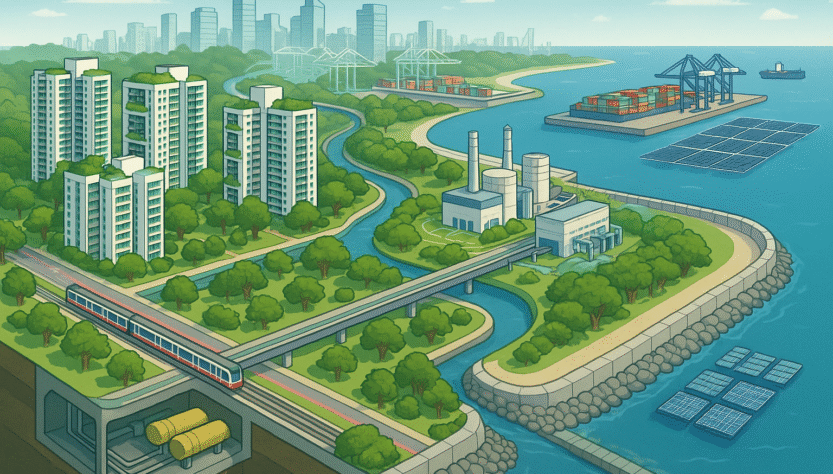
Singapore’s advantage in a resource-scarce world is not natural endowment but orchestrated connectivity. Ports, airports, and logistics corridors are designed as one system, enabling the city to import what it lacks and export the high-value services it produces. Crucially, logistics infrastructure is periodically rearranged to free land and upgrade capacity, a process that turns geography into a strategic variable rather than a fixed constraint.
Port consolidation illustrates the model. By shifting container operations to purpose-built terminals at the island’s edge, older waterfronts are liberated for mixed-use districts with housing, offices, and parks. This trade of cranes for campuses multiplies land value while retaining maritime competitiveness. Similarly, airport expansions are phased, with terminals and runways added as demand grows, optimizing land consumption and surface access.
Behind the scenes, the supply chain is digitized. Real-time tracking, paperless clearance, and data-sharing platforms reduce dwell time and increase throughput without consuming more land. Cold-chain integrity protects food and pharmaceuticals, giving the city flexibility to switch suppliers during shocks. Strategic stockpiles of staples act as buffers, while diversified sourcing spreads risk across regions and seasons.
Industrial estates evolve toward higher value per hectare. Clean rooms, biopharma, advanced manufacturing, and R&D clusters thrive on reliability more than acreage; utilities are delivered at high quality and high uptime. Lower-yield, land-hungry uses are guided to suitable locations or encouraged to upgrade processes. Zoning is not static: plot ratios and permissible uses are recalibrated as new rail lines open or as environmental constraints tighten.
Public finance underwrites the long game. Multi-decade budgets for coastal protection, water plants, and grid reinforcement ensure that critical upgrades are not hostage to annual cycles. Environmental pricing signals—on waste, water, and carbon—align private decisions with public scarcity. In a place where land and natural resources are constrained, logistics mastery and spatial choreography are the true raw materials of growth.