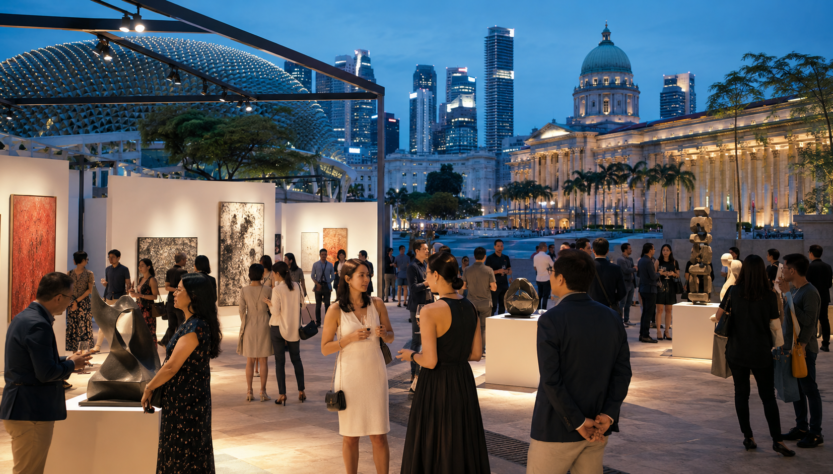
Singapore’s Expanding Influence in the Asian Art Scene
Singapore has undergone a remarkable cultural transformation. Once viewed mainly as a commercial and financial hub, the city-state has gradually built a reputation as one of Asia’s most dynamic destinations for contemporary art and creative industries.
The country’s success comes from combining economic strength with cultural development. By creating strong institutions, supporting artists and attracting international events, Singapore has established itself as a gateway connecting Southeast Asian creativity with the global art market.
Its story demonstrates how a relatively small nation can create significant cultural influence through strategic investment and international cooperation.
Museums as Foundations of Cultural Leadership
The development of Singapore’s art ecosystem has been strongly supported by major cultural institutions.
National Gallery Singapore has become a central figure in promoting Southeast Asian art internationally. The museum’s extensive collection and exhibitions provide insight into the artistic histories of Singapore and surrounding countries.
By highlighting regional artists, the institution contributes to a broader understanding of Southeast Asia’s cultural identity.
More details can be accessed through:
The museum’s presence has also encouraged greater interest among international visitors, researchers and collectors who want to understand the region’s artistic development.
Singapore’s cultural network is strengthened further by Esplanade – Theatres on the Bay, which has become a landmark for performing arts, and the Singapore Art Museum, which focuses on contemporary artistic exploration.
Public Policy as a Driver of Artistic Development
Singapore’s creative growth has not happened by chance. It has been supported by carefully designed cultural strategies.
The National Arts Council Singapore works to strengthen the arts sector by supporting creators, organisations and public participation.
Its programmes are designed to ensure that artistic development remains sustainable while encouraging more people to engage with cultural activities.
Official information is available at:
Through initiatives such as the Our SG Arts Plan 2023–2027, Singapore continues to develop a framework that connects creativity, education and community involvement.
This approach has allowed the arts to become part of the country’s wider development strategy rather than existing separately from economic and social priorities.
The Impact of ART SG and Singapore Art Week
International recognition of Singapore’s art scene has increased through major cultural events.
ART SG has helped introduce Singapore to a global audience of collectors, galleries and art professionals. The event provides a platform for contemporary artists while strengthening the city’s position within the international art calendar.
Singapore Art Week expands this influence by turning the entire city into a cultural destination. Museums, galleries, public spaces and creative organisations participate through exhibitions, discussions and performances.
These events demonstrate Singapore’s ability to combine commercial opportunities with cultural exchange.
A Bridge Between Global and Southeast Asian Art
Singapore’s greatest advantage is its position as a connector.
The city provides access to the diverse artistic traditions of Southeast Asia while maintaining strong relationships with international cultural networks.
For artists from countries such as Indonesia, Thailand, Malaysia, Vietnam and the Philippines, Singapore offers opportunities to reach new audiences and establish international connections.
For collectors and institutions, the city provides a convenient location to explore one of the world’s most diverse cultural regions.
Maintaining Creativity in a Changing Environment
Despite its achievements, Singapore’s arts sector continues to face challenges.
Growing global competition means that cultural centres must constantly adapt. Maintaining affordable creative spaces, encouraging independent artistic voices and supporting young creators will remain important priorities.
Singapore’s future success will depend not only on its museums and major events but also on its ability to encourage experimentation.
By combining strong infrastructure with creative freedom, Singapore can continue evolving from a regional art destination into a global cultural influencer.