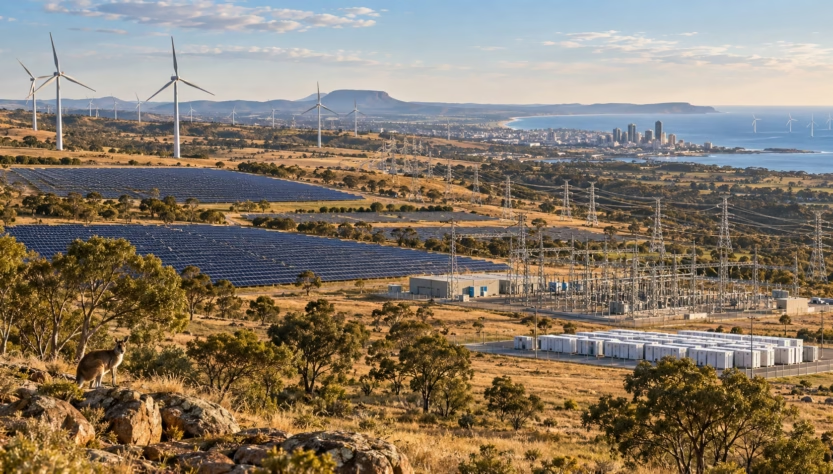
Australia’s renewable energy transition has a dirty secret: solar and wind are variable. They generate power when the sun shines and the wind blows, but they cannot be dispatched on demand. Grid-scale batteries have emerged as one solution, providing short-duration storage that shifts excess solar generation into the evening peak. But batteries have limitations. Most commercial lithium-ion systems provide two to four hours of storage, which is insufficient to cover the longer periods of low renewable generation that can stretch for days. This is where pumped hydro energy storage becomes critical.
Pumped hydro works on a simple principle: when electricity is abundant and cheap, water is pumped uphill to a reservoir. When power is needed, the water is released downhill through turbines to generate electricity. It is a proven technology that has been used for decades, but Australia has not built a new pumped hydro project in forty years. That drought is finally ending, and the projects now under construction will test whether Australia can deliver the long-duration storage its future grid requires. AEMO’s draft 2026 Integrated System Plan implies storage must expand to 55 gigawatts and 618 gigawatt-hours by 2050, and not just short-duration batteries.
The Kidston Pumped Storage Hydro Project in Queensland represents the most advanced of these efforts. Owned by Genex Power and now backed by Japanese company J-Power, the 250-megawatt, eight-hour facility is being built using a former open-pit gold mine approximately 285 kilometres west of Townsville. The project is the first pumped hydro scheme to be registered in Australia’s main grid in four decades and the first ever developed by a private company. Its innovative use of an abandoned mine site as the lower reservoir has attracted international attention as a model for repurposing industrial land.
However, Kidston has not been without difficulties. The project has suffered delays and is now not due for completion until the third quarter of 2027, having originally been scheduled to come online in 2026. In 2022, tunnel drilling penetrated water-bearing rock, requiring drill holes to be plugged, and industrial action has also held up progress. More recently, Genex abandoned the wind component of its proposed hybrid project at the site, citing the prohibitive cost of building wind turbines on the rocky, remote terrain. The company will instead focus on an enlarged 200-megawatt, four-hour battery to complement the pumped hydro facility.
The much larger Snowy 2.0 project in New South Wales continues to face significant challenges. When complete, it will provide 2 gigawatts of generation capacity and 350 gigawatt-hours of storage, enough to power three million homes continuously for a week. But the project has been plagued by cost blowouts and delays that have made it a cautionary tale about the difficulties of large-scale infrastructure delivery. Snowy Hydro recently achieved a major excavation breakthrough, but the project remains years away from completion.
The pipeline of proposed pumped hydro projects beyond Kidston and Snowy 2.0 is substantial on paper but slow to materialise. Only one other private pumped hydro project has development approval in Australia—Yancoal’s Stratford project in New South Wales—while five others in New South Wales have development applications underway, with all but one waiting for a decision for three to five years. This regulatory bottleneck threatens to delay the long-duration storage capacity that AEMO’s modelling indicates will be needed as coal generators retire.
The long-duration storage challenge is not insurmountable, but it requires a bankable pathway that currently does not exist. As the International Hydropower Association has noted, Australia cannot reach net zero on optimism alone. Pumped hydro projects require long development timelines, complex environmental approvals, and substantial upfront capital. Without clear market signals and supportive policy frameworks, private investors will continue to hesitate. The coming years will reveal whether Australia can convert its pumped hydro ambitions into operational assets—or whether it will find itself relying on shorter-duration batteries to fill gaps they were never designed to cover. For information on pumped hydro projects and storage policy, visit https://www.energy.gov.au/.