The Urban Food Security Imperative
As Malaysia’s most urbanised state, Selangor faces a distinctive food security challenge: how to feed a densely concentrated population whose access to fresh produce depends on supply chains that stretch far beyond its borders. The state’s response has increasingly centred on urban agriculture, with community gardens emerging as a practical mechanism for localising food production.
As of 2025, a total of 391 registered community gardens had been established across Selangor, monitored by local authorities and the Selangor Agriculture Department. Notably, 86% of these gardens are located in urban areas, underscoring the significant potential of urban agriculture in addressing food access challenges in the state’s cities and towns.
Beyond Food Production: Social and Economic Benefits
Professor Datin Dr Fatimah Mohamed Arshad, Food Security Chair Holder at Universiti Putra Malaysia (UPM), has emphasised that the benefits of community gardens extend well beyond the produce they yield. Urban agriculture practices enable residents to reduce living costs while raising awareness of healthy eating habits and environmental sustainability. The produce can be consumed by households or shared within the local community, creating a direct link between cultivation and consumption that conventional supply chains cannot replicate.
The social dimension of these gardens is equally significant. Fatimah noted that community gardens bring together residents from various ethnic backgrounds and age groups, fostering unity and a stronger sense of belonging through shared work and knowledge exchange. In a state as diverse as Selangor, this social cohesion function may prove as valuable as the vegetables harvested.
Associate Professor Dr Seri Intan Mokhtar, Dean of the Faculty of Agro-Based Industry at Universiti Malaysia Kelantan, has described the development of urban farms in Selangor as a strategic initiative to ensure access to safe and nutritious food, particularly for urban communities. She observed that while community gardens are currently small in scale, their potential is substantial if systematically planned and supported by clear policies.
Technology Integration: From Community Plots to Vertical Farms
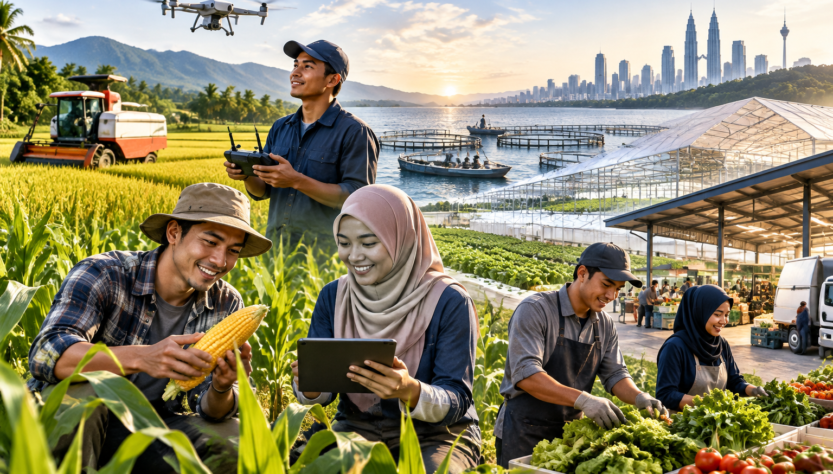
The future trajectory of urban agriculture in Selangor is increasingly intertwined with technology. Fatimah has argued that urban agriculture has the potential to become a significant contributor to the state’s food security if implemented on a wider scale and supported by modern technologies such as vertical farming, smart greenhouses, and aquaponics systems.
This technology-enabled vision is already taking shape in specific projects. In the Semenyih area, a home garden has introduced vertical aquaponics, a method well suited to limited urban spaces. The system combines aquaculture—the controlled cultivation of aquatic organisms such as fish—with hydroponics, the soil-free cultivation of plants. Its vertical setup allows for denser planting while using significantly less water.
In Perak, two districts have seen their agriculture sectors boosted by smart technology, with pioneer projects using fully climate-controlled indoor farming systems that include vertical farming with control over light, temperature, humidity, nutrients, and air quality. While not in Selangor, these examples demonstrate the technological possibilities that could be adapted for urban contexts.
Policy Support and Future Scaling
The Selangor government has signalled its commitment to expanding urban agriculture through the Selangor Agro Transformation Plan (PeTA), which focuses on strengthening the food supply chain from seed production and breeding to marketing while boosting productivity and income within the state’s agricultural sector.
The alignment between state-level initiatives and the national policy framework is notable. The NFSP 2030 Action Plan includes initiatives to propel crop diversification and stimulate dietary diversity, objectives that community gardens directly support by enabling residents to grow and access a wider variety of fresh produce.
For urban agriculture to achieve its potential at scale, however, several barriers must be addressed. Access to land, water, and technical knowledge remain unevenly distributed. The technology costs associated with vertical farming and smart greenhouse systems may be prohibitive for community groups without external support. And the policy environment must evolve to integrate urban agriculture more systematically into land use planning and local food system governance.